
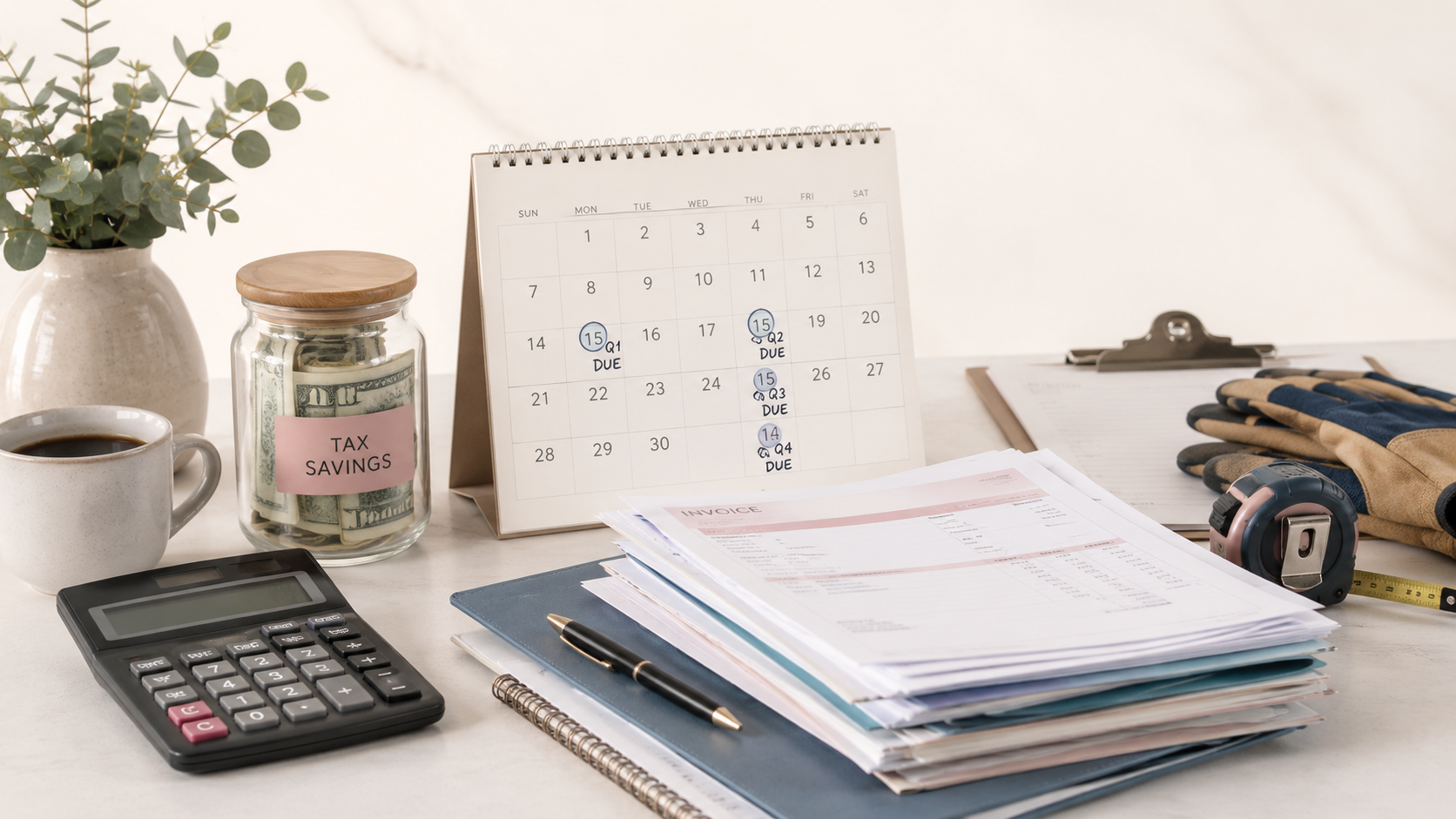
Estimated Tax Payments for Self-Employed Business Owners: Due Dates, What to Review, and How to Plan
If you are self-employed, estimated taxes are one of those tax things that can feel easy to ignore, until one of the deadlines shows up waving at you from the calendar.
The easiest way to understand estimated taxes for self-employed business owners is this: they are the taxes you would normally owe by April 15, paid throughout the year instead of all at once at tax time.
When those payments are missed, too low, or not planned for, the IRS and your state may add penalties or interest. Because apparently, they do not love when we hold their money too long.
Rude, but true.
But if you estimate well and pay in enough during the year, you may owe little to nothing when April 15 comes around.
That is the goal — managing your money with insight, so tax time does not feel like an emergency call after the damage is already done.
Before you dive into the full article, here’s a quick video with one simple way to think about estimated taxes as a self-employed business owner.
What Are Estimated Taxes for Self-Employed Business Owners?
For self-employed business owners, estimated taxes are how you pay in toward the taxes that are not being withheld from a paycheck.
That usually includes two main pieces:
- Income tax on the profit your business earns
- Self-employment tax, which covers Social Security and Medicare
When you work as an employee, part of this happens automatically. Taxes are withheld from your paycheck, and your employer also pays part of the Social Security and Medicare side.
But when you work for yourself, there is no employer quietly handling that in the background.
You are the business owner.
You are also, in a way, the employer and the employee.
That means you are responsible for paying in toward income tax, Social Security, and Medicare yourself.
And while no one loves sending money to taxes, the Social Security portion does matter. Your future Social Security benefit is based, in part, on your earnings record. So when self-employment income is reported properly and self-employment tax is paid, it helps build that record.
It is not exciting. It is not glamorous. But it is part of running the business like a real business.
If your business makes a profit, a portion of that profit may need to be set aside before you treat the rest as money available to spend, reinvest, or take home.
When Are Estimated Tax Payments Due?
For many calendar-year taxpayers, estimated tax payments are generally due four times a year:
- April 15
- June 15
- September 15
- January 15 of the following year
These are the common individual estimated tax due dates, which often apply to sole proprietors, single-member LLC owners, partners, and S corporation shareholders who pay tax on business income through their personal return.
Corporations may have different estimated tax due dates, so if your business is taxed as a C corporation, that should be reviewed separately with your tax professional.
These dates matter because estimated taxes are not meant to be handled only once a year.
Each deadline is a good time to pause and look at your numbers. Not just your bank balance. Your real numbers.
A few things worth asking:
- Is profit higher or lower than expected?
- Have expenses changed?
- Are you setting money aside for taxes?
- Are owner draws getting too high?
- Is the business cash tight even though sales are coming in?
These are not just tax questions. They are business questions.
Because estimated taxes should not only be about avoiding a surprise bill. They should also be about understanding whether your business is producing enough profit and cash to support taxes, owner pay, expenses, and reserves.
Why Estimated Taxes Matter for Self-Employed Business Owners
Estimated taxes matter because profit is not the same thing as take-home money.
This is where many self-employed business owners get tripped up.
The bank account may look okay. Sales may be steady. The business may even be profitable.
But if nothing has been set aside for taxes, that profit can create stress later.
Ignoring estimated taxes can lead to:
- A larger balance due at tax time
- Penalties or interest
- Cash flow pressure
- Pulling from savings unexpectedly
- Using credit cards or loans to cover tax payments
That does not mean you need to obsess over taxes every week.
But you do need a simple system for knowing what is coming in, what is going out, what profit looks like, and what portion of that profit may need to be protected for taxes.
Because “I’ll figure it out in April” is not a tax plan. It is a future problem wearing a little calendar reminder.
How Much Should You Set Aside for Estimated Taxes? A Simple Rule of Thumb
This is the question almost every self-employed business owner asks, and the honest answer is that it depends on your profit, your deductions, your filing status, and your state.
But most people do not have perfectly reconciled books every month. And that is okay.
If you know your sales, you have enough to start.
The revenue-based rule of thumb: set aside 25% of gross revenue.
For every dollar deposited into your account, move 25 cents into a separate savings account designated for taxes.
Do not wait until the end of the month.
Do not wait until the deadline.
Do it on every deposit.
To make this even more simple: set a bank rule so that 25% of every deposit gets moved to your tax saving bank account.
When you eventually reconcile your books or work with your tax professional, you can fine-tune the number. But 25% of gross revenue is a defensible starting point that almost never leaves a business owner short.
This is a general planning guideline, not a personalized tax calculation. Your actual liability depends on your specific deductions, filing status, and state. Schedule a consultation to get your precise number.
The Problem with Guessing
A lot of business owners handle estimated taxes by guessing.
They pay what they paid last time. They send whatever cash is available. Or they skip the payment because the money is needed somewhere else.
I understand why that happens.
When the books are behind or unclear, guessing can feel like the only option.
If your books are behind or unclear and you are heading into an estimated tax deadline without real numbers to work from, a Diagnostic Review & Roadmap can help you understand where things stand and what needs to be cleaned up.
But guessing does not give you control.
If you underpay, you may be creating a larger tax problem later. If you overpay, you may be sending cash out of the business that you actually needed for payroll, equipment, materials, debt, or reserves.
The goal is not perfection. The goal is to make a more informed decision based on what is actually happening in the business.
What to Review Before an Estimated Tax Deadline
Your tax professional should be the one helping you calculate what to pay and how much to send.
But the numbers behind that calculation usually start with your books.
Before making an estimated tax payment, it helps to look at more than your bank balance. The money in the bank does not always tell the full story. Some of that cash may already be needed for upcoming bills, payroll, materials, debt payments, owner pay, or taxes.
Here are a few numbers worth reviewing before an estimated tax deadline:
Year-to-Date Profit
Start with your profit and loss report for the year so far.
- Are you profitable?
- Is profit higher or lower than expected?
- Has anything changed compared to last year?
Not sure if your P&L is telling the full story? A Diagnostic Review can help identify where your books may need cleanup or restructuring.
Owner Draws or Distributions
If you are taking money out of the business, make sure those withdrawals are being tracked properly.
For sole proprietors and many single-member LLCs, owner draws do not reduce taxable profit. That means you can take money out of the business and still owe tax on the profit the business earned.
This is one of the areas where self-employed business owners can get caught off guard.
The business may feel cash tight because money is leaving the account, but the tax bill is still being calculated based on profit. That is an important difference.
Cash Set Aside for Taxes
Do you have money set aside for taxes, or is everything sitting in one operating account?
If all the money is mixed together, it is easy to spend cash that may really need to be saved for taxes.
A separate tax savings system does not need to be complicated. The goal is simply to keep tax money visible and protected.
Even if the amount needs to be adjusted later, having a system is better than hoping the money is still there when the deadline shows up.
Hope is lovely. It is not a tax savings strategy.
Business Changes
Estimated taxes should not be based on last year. It’s a new year.
A few changes that can affect your tax picture include:
- Higher or lower income
- New services or pricing changes
- Hiring help
- Buying equipment
- Taking larger owner draws
- Paying down debt
- Losing or gaining a major customer
- Other sources of personal income
If the business has changed, your estimated tax planning may need to change too.
This is especially important for growing businesses. More revenue can be exciting, but more profit can also mean a higher tax bill if you are not planning for it.
Good problem? Maybe. Still need a plan? Absolutely.
State Taxes
Federal estimated taxes are only part of the picture.
Depending on where you live and do business, you may also need to make state estimated tax payments.
It is easy to focus on the IRS and forget the state side, but both can affect your cash flow.
And nobody wants to handle one tax surprise just to discover there was another one waiting quietly in the corner.
What If You Cannot Pay the Full Amount?
If you are looking at the deadline and realizing you may not have enough cash available, do not ignore it.
This is a signal to review the numbers.
You may need to talk with your tax professional about what payment makes sense, whether penalties could apply, and how to adjust going forward.
You may also need to look at why the cash is not available.
If you are not sure why the cash is not there, a Diagnostic Review can help you understand what your numbers are actually showing — and where the gaps are.
The goal is not to shame yourself for being behind. The goal is to use the information to build a better system.
Because the deadline is not the real problem. The real problem is not knowing the number until the pressure is already on.
Final Thoughts
Estimated taxes may feel like just another deadline, but they are really a check-in point for your business.
Not just your tax situation. Your business.
If you are self-employed, the money you earn has to support more than today’s expenses. It also has to support taxes, owner pay, reserves, and future decisions.
That is why estimated taxes matter. They help you avoid surprises, plan with more confidence, and build a stronger financial foundation.
Simple systems. Sensible numbers. Smarter decisions.
That is what helps you move from guessing to knowing.
Frequently Asked Questions: Estimated Taxes for Self-Employed Business Owners
How much should I set aside for estimated taxes as a self-employed business owner?
A simple starting point is 25% of your gross revenue, set aside on every deposit into a separate account. If you have well-organized books, a more precise target is 25–30% of net profit. The right amount ultimately depends on your total income, deductions, filing status, and state tax obligations. Your tax professional can help you calculate a more accurate figure based on your specific situation.
What happens if I miss an estimated tax payment?
Missing or underpaying an estimated tax payment may result in a penalty from the IRS, even if you pay the full balance by April 15. The penalty is based on the amount underpaid and how long it went unpaid. Your tax professional can help you understand whether a penalty applies and how to address it.
Do I have to make estimated tax payments if my business had a loss last year?
Not necessarily, but it depends on what your income looks like this year. If your business is profitable this year, estimated payments may still be required even if last year was a loss. This is one reason why reviewing your current year numbers — not just last year’s — matters before each deadline.
Can I skip estimated taxes and just pay everything in April?
You can, but you may face underpayment penalties. The IRS generally expects tax to be paid as income is earned throughout the year, not only at the end. If you consistently owe more than a certain threshold at tax time, penalties may apply.
What if my income is inconsistent or seasonal?
Inconsistent or seasonal income makes estimated tax planning harder, but it does not make it optional. The IRS does allow an annualized income installment method that adjusts payments based on when income is actually earned, rather than spreading it evenly across four quarters. A tax professional can help you determine whether that approach makes sense for your business.
My books are a mess and I have no idea what my profit actually is. Where do I start?
This is exactly where a Diagnostic Review & Roadmap can help. Before you can plan for estimated taxes with any confidence, you need books that are accurate and organized. A Diagnostic Review looks at the current state of your books, identifies what needs to be cleaned up, and gives you a clear roadmap for getting your numbers into a place where they can actually support decisions — including tax planning.
Disclaimer: This post is for general informational purposes only and does not constitute tax or financial advice. Every business and tax situation is different. The percentages and guidelines shared here are general planning rules of thumb, not a substitute for personalized advice. Please work with a qualified CPA or tax professional for guidance specific to your income, deductions, filing status, and state obligations.